New Zealand
 As
a New Zealand gesture of welcome we say "Kia Ora".
As
a New Zealand gesture of welcome we say "Kia Ora".
New Zealand is famous all over the world for things like bungy
jumping, jet boating, kiwifruit and millions of sheep. Our national
sport is rugby; our national icon is the Kiwi, a flightless nocturnal
bird.
New Zealanders love the great outdoors, but we
also make a good espresso and our arts festivals are international
draw cards.
Kiwis believe they can do anything and love a challenge to prove
it. That "can do" attitude has seen Kiwis excel in many
areas.
 Did
you know that...
Did
you know that...
New Zealand is the first country to see the day.
New Zealand was the first country in the world (1893) to give
women the vote!
Sir Edmund Hillary (a Kiwi) was the first person to climb Mt Everest.
New Zealand currently holds the America's Cup.
"Popstars" is a New Zealand franchise. (Sorry)
Population
New Zealand is an independent nation and a member of the British
Commonwealth. It has a diverse multi-cultural population of around
3.8 million people. The majority of New Zealanders are of British
descent, and the largest minority is New Zealand's indigenous
Maori who make up around 14 percent of the population.
Language
English is the common and everyday language of New Zealand.
You may also hear Maori, which is also an official language of
New Zealand.
 Early
Settlement
Early
Settlement
The Maori were New Zealand's first settlers. They made an epic
journey from legendary Hawaiki, probably in Polynesia to the north
of New Zealand, about 1000 years ago. The great explorer Kupe,
who legend says first discovered New Zealand, named the new land
Aotearoa - Land of the Long White Cloud.
The first documented European to discover New
Zealand was Dutch navigator Abel Tasman who came here in 1642
in search of the fabled great southern continent. Over a century
and a quarter later Captain James Cook claimed it for Britain
in 1769 and produced a map.
The Treaty of Waitangi
The Treaty of Waitangi is New Zealand's founding document and
established the country as a nation. It was signed in 1840 between
leading Maori chiefs and representatives of the British Crown.
The location, at Waitangi in the Bay of Islands, is now one of
the country's most historic sites. The signing of the treaty began
on 6 February, which has become New Zealand's national day, known
as 'Waitangi Day'.
Economy and Government
New Zealand is a modern country with a well-developed economy
and a government structure based on the British parliamentary
system. New Zealand has long been a sovereign nation in its own
right with only tenuous ties to Britain through New Zealand's
membership of the British Commonwealth.
Kiwis and kiwis
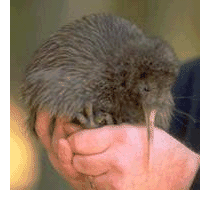
New Zealand's first settlers, the Maori, named the kiwi bird for
the sound of its chirp - kiwi, kiwi, kiwi! This flightless bird,
about the size of a domestic hen, has an extremely long beak and
plumage more like hair than feathers. New Zealanders have adopted
this nocturnal, flightless and endearing creature as their national
emblem.
Referring to New Zealanders as Kiwis probably
dates back to the First World War, when New Zealand soldiers acquired
this nickname.
In the international financial markets, the New
Zealand dollar, the basic currency unit, is frequently called
the Kiwi. The dollar coin features a kiwi bird on one side.
Perhaps the best-known kiwi is the kiwifruit.
Originating in China, kiwifruit were grown in New Zealand domestic
gardens for decades as Chinese gooseberries. However, when enterprising
New Zealand farmers began propagating the fruit intensively for
export, it was given the name kiwifruit.



